ULTRACURE P520, Structural Adhesive for Bonding Polypropylene and Polyethylene
Description
ULTRACURE® P520 is a two-part, 10:1 structural adhesive for bonding polypropylene and other low surface energy plastics —polyethylene (HDPE, LDPE and UHMWPE), thermoplastic polyolefins (TPO), PTFE and PVC— with no primer and no surface treatment.
These plastics hinder wetting and adhesion of conventional adhesives. For bonding polypropylene, P520 needs no primer and no surface treatment: bonding surfaces only have to be clean, dry and free of dust, grease and other contaminants. It also works as a high density polyethylene adhesive and bonds nylon (PA).
Dispensed from a 10:1 dual cartridge through a static mixing nozzle, it maintains its strength over a service temperature range of −54 to 249 °F (−48 to 121 °C) and resists humidity and water.
In ASTM D 1002 shear testing it exceeds 1,247 PSI (8.6 MPa) on PP/PP and 1,392 PSI (9.6 MPa) on TPO/TPO; on polypropylene and on all three polyethylene grades the substrate fails first: the plastic breaks before the bond.
No Primer Needed
P520 bonds polypropylene, PE, TPO, PTFE and PVC with no primer and no surface treatment: surfaces only need to be clean, dry and free of contaminants.
10:1 Dual Cartridge Mixing
Resin and activator mix at 10:1 by volume in the static mixing nozzle, with 2–3 min of open time for assembly.
From −54 to 249 °F
Maintains its strength across this service temperature range and resists humidity and water.
How Do You Apply ULTRACURE P520 for Bonding Polypropylene?
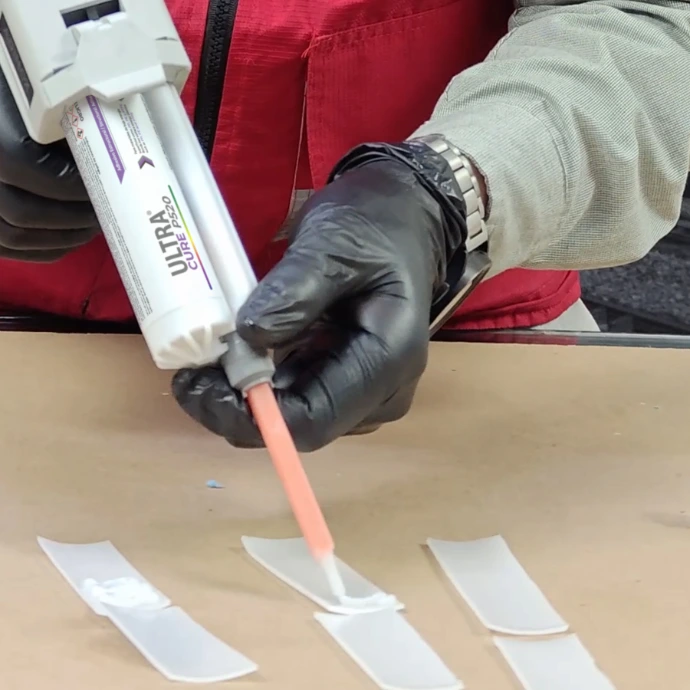
1. Prepare the surfaces: they must be clean, dry and free of dust, grease and other contaminants. No primer or surface treatment is required on the verified substrates.
2. Load the 10:1 dual cartridge into a manual or pneumatic applicator gun for 10:1 cartridges and purge the cartridge before attaching the static mixing nozzle.
3. With the nozzle in place, purge again until the adhesive shows a uniform color. Heat build-up during and after mixing is normal.
4. Dispense enough adhesive to completely fill the joint when the parts are clamped. The gap must stay between 0.04 and 0.11 in (1 and 3 mm).
5. Mate the surfaces within the open time (2–3 min) and keep the parts undisturbed until handling strength is reached: 2–3 h at 77 °F (25 °C).
6. Full properties develop in 24 hours at 77 °F (25 °C). Below 56 °F (13 °C) cure slows and above 84 °F (29 °C) it accelerates; to accelerate cure, heat to 121–140 °F (49–60 °C) for 15 minutes.
7. Remove the nozzle after use and cap the cartridge. Mixing nozzles are single-use.
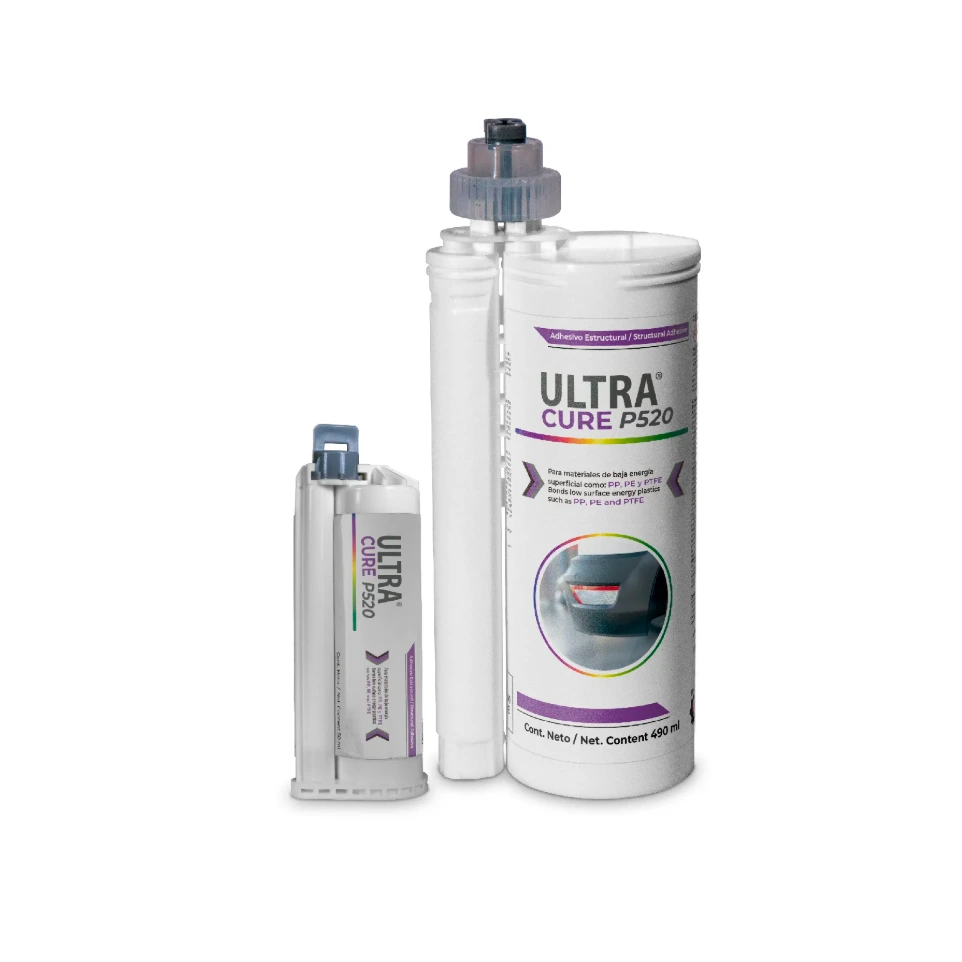
For bonding polypropylene parts in assembly or repair, ULTRACURE P520 comes in 10:1 dual cartridges of 50 ml and 490 ml.
P520 Specifications: Polypropylene and High Density Polyethylene Adhesive
- A 10:1 two-part adhesive for structural bonding of low surface energy plastics such as polypropylene, polyethylene, TPO and PTFE.
- Verified substrates: polypropylene (PP); high-density (HDPE), low-density (LDPE) and ultra-high-molecular-weight polyethylene (UHMWPE); thermoplastic polyolefin (TPO); PTFE; PVC and nylon (PA).
- Gap fill of 0.04 to 0.11 in (1 to 3 mm): not designed for larger gaps.
- Bond strength on PTFE is lower and failure is adhesive.
- Use only 10:1 cartridges and compatible mixing nozzles: an incorrect mix ratio results in incomplete cure. Outside 56–84 °F (13–29 °C) cure times change.
- The curing reaction is exothermic: do not accumulate adhesive masses thicker than the maximum gap fill (0.11 in / 3 mm) or leave mixed adhesive in the nozzle or in closed containers.
- Flash point: see SDS. Keep away from heat sources, sparks and open flames.
- Use in well-ventilated areas with the personal protective equipment indicated in the SDS. Read the SDS before use and keep containers tightly closed when not dispensing.
Uncured Material
Property | Part A | Part B |
Appearance | Amber | Cream |
Viscosity @ 77 °F (25 °C) | 9,500–11,500 cP | 7,500–8,500 cP |
Density | ~1,05 g/cm³ | ~1,07 g/cm³ |
Mix ratio by volume | 10 | 1 |
Cured Adhesive
Open time | 2–3 min |
Working time (handling) | 2–3 h |
Full cure | 24 h |
Gap fill | 0.04–0.11 in (1–3 mm) |
Shore D hardness | 52–58 |
Modulus @ 1% strain | 81,900–84,900 PSI (565–586 MPa) |
Elongation | 6–9 % |
Service temperature | −54 to 249 °F (−48 to 121 °C) |
Cure times at 77 °F (25 °C).
Lap Shear Strength (ASTM D 1002)
Substrates | Strength | Failure mode |
PP / PP | >1,247 PSI (>8.6 MPa) | Substrate failure |
HDPE / HDPE | >1,087 PSI (>7.5 MPa) | Substrate failure |
LDPE / LDPE | >899 PSI (>6.2 MPa) | Substrate failure |
UHMWPE / UHMWPE | >696 PSI (>4.8 MPa) | Substrate failure |
TPO / TPO | >1,392 PSI (>9.6 MPa) | Cohesive failure |
PTFE / PTFE | >290 PSI (>2.0 MPa) | Adhesive failure |
PVC / PVC | >1,987 PSI (>13.7 MPa) | Adhesive failure |
Single-lap joints, same substrate on both sides.
Storage and Package Sizes
What Do People Ask About Bonding Polypropylene with P520?
It is an adhesive for low surface energy plastics —PP, PE, TPO, PTFE and PVC— that bonds them with no primer and no surface treatment. These plastics hinder wetting and adhesion of conventional adhesives; ULTRACURE P520 bonds them structurally: on PP/PP it exceeds 1,247 PSI (8.6 MPa) shear strength (ASTM D 1002) with substrate failure.
No. P520 requires no primer or surface treatment on the verified substrates: surfaces only need to be clean, dry and free of dust, grease and other contaminants.
Yes. It bonds high-density (HDPE), low-density (LDPE) and ultra-high-molecular-weight polyethylene (UHMWPE). In ASTM D 1002 testing it exceeds 1,087 PSI (7.5 MPa) on HDPE/HDPE, 899 PSI (6.2 MPa) on LDPE/LDPE and 696 PSI (4.8 MPa) on UHMWPE/UHMWPE, with substrate failure in all three cases.
Yes, with lower strength than on polyolefins: it exceeds 290 PSI (2.0 MPa) on PTFE/PTFE (ASTM D 1002) and failure is adhesive, meaning the interface separates before the material breaks. On PTFE, the joint design should be validated in the actual application.
With P520, open time is 2–3 min from the moment the adhesive leaves the nozzle. Parts reach handling strength in 2–3 h and full cure in 24 hours, both at 77 °F (25 °C).
From 0.04 to 0.11 in (1 to 3 mm). P520 is not designed for larger gaps and, because the curing reaction is exothermic, adhesive masses thicker than that maximum should not be accumulated.
From −54 to 249 °F (−48 to 121 °C). Within this range P520 maintains its strength, and it also resists humidity and water.
Below 56 °F (13 °C) cure slows and above 84 °F (29 °C) it accelerates. To accelerate cure, heat to 121–140 °F (49–60 °C) for 15 minutes.
Before it cures, remove excess from the work area and equipment using a suitable cleaning solvent compliant with local VOC regulations. Mixing nozzles are single-use: replace the nozzle at each application and keep the cartridge capped.
Where to Buy ULTRACURE P520?
Find it through our distributor network in 50 ml and 490 ml 10:1 dual cartridges.
Are you a distributor? Join our network and offer your customers 10:1 structural adhesives for bonding polypropylene and polyethylene.