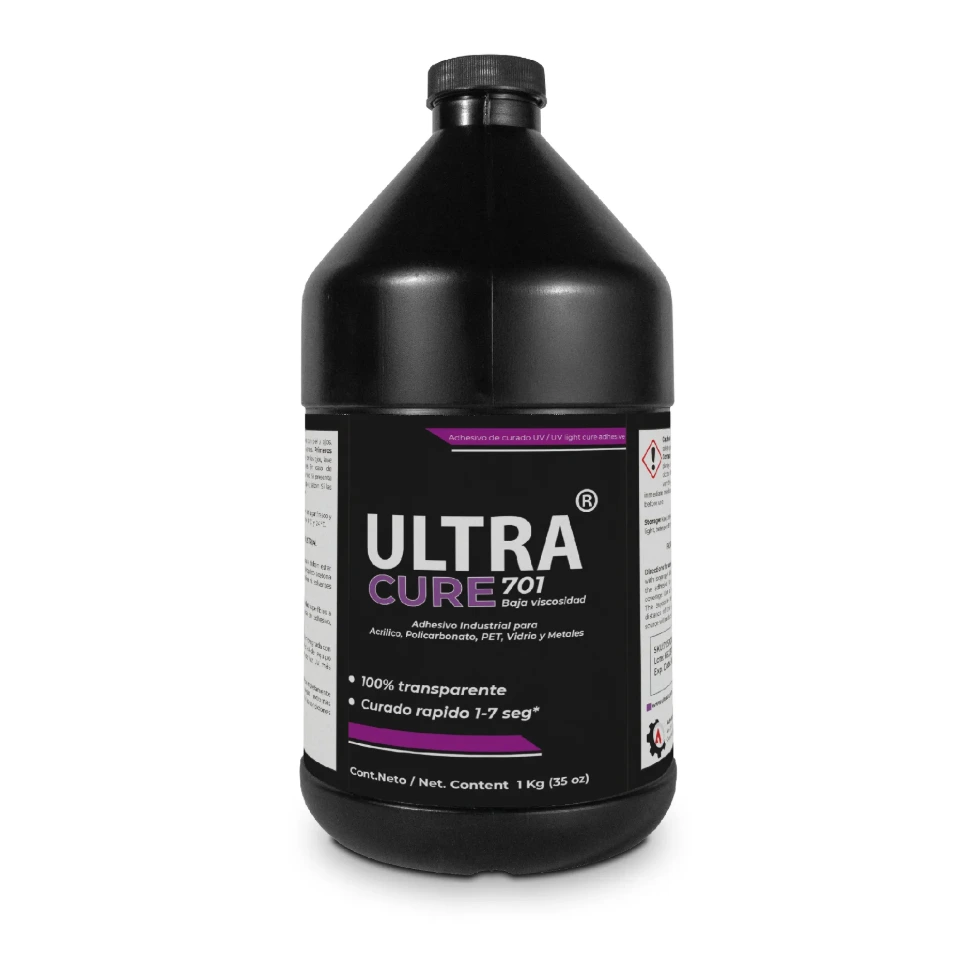
ULTRACURE® 701 — Low-Viscosity UV Adhesive
Description
ULTRACURE 701 is a low-viscosity UV adhesive: a one-component, low-odor, fast-curing UV/visible-light structural adhesive, specifically formulated for structural bonds of acrylic (PMMA), polycarbonate (PC) and glass.
Its 18–22 cP viscosity defines how it works: it is applied by capillary action, flowing into the already-assembled joint instead of being laid down as a bead. It leaves a clear, low-shrinkage finish, resistant to impact, yellowing and sudden temperature changes, with a tensile strength of ≥ 2,755 PSI (≥ 19 MPa).
This adhesive fluoresces orange under UV light, so you can verify that the adhesive has cured without taking the part apart. It is formulated for structural bonds of acrylic (PMMA), glass and polycarbonate (PC), as well as other transparent substrates, and also bonds most metals. Not recommended on PP, PE, PTFE or silicone, nor for environments with high relative humidity or permanent immersion.
Capillary Action
18–22 cP: it flows into the already-assembled joint instead of being laid down as a bead.
Orange Fluorescence
It fluoresces orange under UV light, so you can verify the cure without taking the part apart.
Clear Finish
Low shrinkage, resistant to impact, yellowing and sudden temperature changes.
How Do You Apply the 701 UV Adhesive for Glass?
1. Prepare the surfaces: clean and free of grease, using isopropyl alcohol.
2. Apply the adhesive to one of the surfaces.
3. Assemble the parts.
4. Clean off any excess with isopropyl alcohol before light exposure.
5. Project UV/visible light onto the joint at a recommended distance of 6 cm.
6. Allow the adhesive to develop full strength before applying loads.
Additional Information
- In environments with high relative humidity or permanent immersion. It is not recommended for those conditions. If the bond will be exposed to moisture, the product in the line is ULTRACURE 705.
- If both substrates are opaque. Light curing requires at least one of the two to let 365 nm radiation through. Polycarbonate and UV-absorbing acrylic absorb 365 nm light: verify with a radiometer, behind the substrate, the irradiance that reaches the adhesive.
- On PP, PE, PTFE, silicone or polystyrene. They are not compatible.
- In joints with a large gap. At 18–22 cP, 701 is a capillary adhesive, not a gap filler: for wide gaps, the right product is 705, with its high thixotropic viscosity.
- Setting Time by Lamp Intensity: 6 mW/cm² < 10 seconds · 100 mW/cm² < 5 seconds · 200 mW/cm² < 2 seconds
- Compatible: ABS · Polycarbonate (PC) · PET · PMMA (acrylic) · PVC · Glass · Aluminum · Stainless steel · Polyurethane (PU)
- Not recommended: Polystyrene (PS) · Polyethylene (PE) · Polypropylene (PP) · PTFE · Silicone
- Light protection: keep the container closed and protected from light when not in use, and never return leftover adhesive to the original container.
- Safety: during curing, wear UV protective goggles and gloves; do not look directly at the lamp. Refer to the SDS before use.
- Complies with the RoHS Directive (EU 2011/65/EU and EU 2015/863): it contains no RoHS-restricted substances above the maximum permitted limits.
- +
Appearance
Clear, slightly pale liquid
Main curing
UV/visible light (365 nm)
Viscosity @ 77 °F (25 °C)
18–22 cP
Hardness (Shore D)
83–87
Tensile strength
≥ 2,755 PSI (≥ 19 MPa)
Glass transition temperature (Tg)
158 ± 9 °F (70 ± 5 °C)
Operating temperature
−40 to +257 °F
Density @ 77 °F (25 °C)
1,04–1,06 g/cm³
Flash point
> 199 °F (> 93 °C)
Positioning time
≤ 2 s
Positioning energy
≥ 50 mJ/cm²
Curing time
≤ 35 s
Full cure energy
≥ 1.150 mJ/cm²
Packaging
50 ml, 250 ml and 1 kg containers.
Storage
47 to 75 °F (8 to 24 °C), in a cool, dry place, in the original sealed container, protected from light. Shelf life: 12 months from manufacture date.
701 Frequently Asked Questions
In viscosity and in the working environment. 701 has 18–22 cP and is applied by capillary action on already-assembled joints, with a tensile strength of ≥ 2,755 PSI (≥ 19 MPa). 705 has a high thixotropic viscosity, fills wide gaps and works in vertical applications, and it is the one indicated when the bond will be exposed to moisture. They are complementary products, not interchangeable.
No. This adhesive is not recommended for environments with high relative humidity or for permanent immersion. If the bond will be exposed to those conditions, the product in the line is ULTRACURE 705, whose water absorption is below 2 % and which is described precisely by its water and moisture resistance.
To inspect the bond without taking it apart. Under UV light the adhesive shows orange fluorescence, so you can see where it is and how it spread inside the joint. In quality control, this lets you catch a bond with insufficient or poorly distributed adhesive before the part moves on down the line.
No. It leaves a clear finish after curing and does not yellow over time, which makes it suitable for visible bonds on acrylic, polycarbonate and glass. It also resists yellowing and sudden temperature changes.
A 365 nm UV curing lamp, at a recommended distance of 6 cm. Time depends on intensity: at 6 mW/cm², setting is reached in under 10 seconds; at 100 mW/cm², in under 5; and at 200 mW/cm², in under 2. Full cure requires ≥ 1,150 mJ/cm².
No. Light curing requires at least one of the two substrates to be translucent and let 365 nm radiation through. It is a physical limitation of light curing, not of the product, and it has to be solved in the joint design.
Because its photoinitiators are activated across a range of wavelengths, not only by the curing lamp. Sunlight and many light fixtures emit a spectrum that includes that range, so accidental exposure can form a surface skin or gel that renders the adhesive unusable. That is why the container stays closed and protected, and leftover adhesive is never returned to the original container.
Yes. Glass is one of its compatible substrates, together with acrylic (PMMA), polycarbonate (PC), ABS, PET, PVC, aluminum, stainless steel and polyurethane (PU). Ordinary glass lets 365 nm light through, so the bond cures through it, including glass-to-metal bonds. Its low viscosity (18–22 cP) lets it flow by capillary action into already-assembled joints, and it leaves a clear finish that does not yellow over time.
With three figures from the technical data sheet. Viscosity decides whether the adhesive flows in by capillary action: 701 has 18–22 cP. The cure wavelength has to match the lamp: it cures at 365 nm. And the service environment: for acrylic, polycarbonate and glass indoors, it offers ≥ 2,755 PSI (≥ 19 MPa) tensile strength and does not yellow; if the bond will be exposed to moisture, the right product is ULTRACURE 705.
Where to Buy
ULTRACURE 701?
Find it through our distributor network in 50 ml, 250 ml and 1 kg containers.
Are you a distributor? Join our network and offer your customers UV-curing adhesives for industrial assembly.