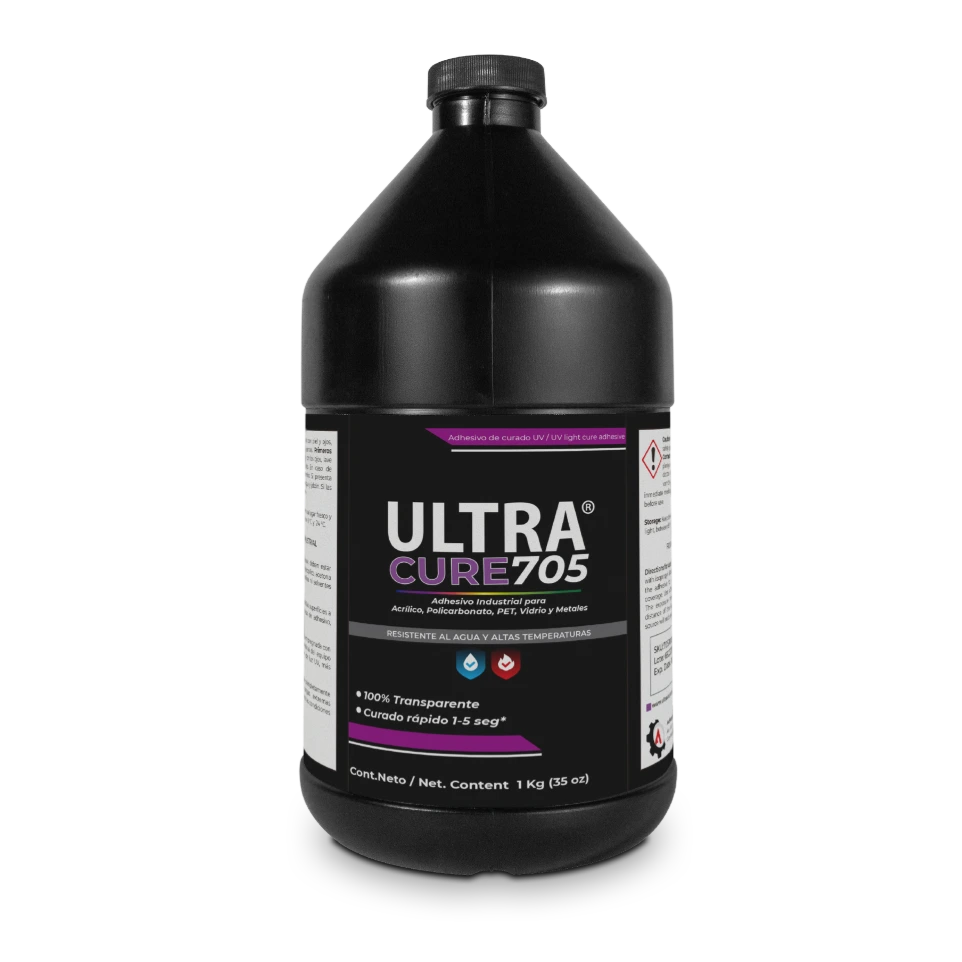
ULTRACURE® 705 — UV-Curing Adhesive, High Viscosity, Flexible and Moisture-Resistant
Descripción
ULTRACURE 705 is a flexible UV adhesive: a single-component structural adhesive that cures under ultraviolet light and offers excellent water and moisture resistance. Its flexible nature lets it withstand vibration and dimensional changes without cracking, and its water absorption below 2 % makes it suitable for joints exposed to moisture.
Its high thixotropic viscosity makes it a high viscosity UV adhesive well suited to filling large gaps, to vertical applications —where it does not sag— and to the encapsulation and sealing of electronic components. With Shore A 55, 705 cures to an elastic, not rigid, material: that is the key difference from the other UV adhesives in the line.
Suitable for bonding and sealing glass, metals and plastics. Not recommended on PP, PE, PTFE or silicone.
Flexible, Shore A 55
It cures to an elastic, not rigid, material that withstands vibration and dimensional changes without cracking.
Moisture-Resistant
Water absorption below 2 %, for joints exposed to moisture.
Fills Wide Gaps
High thixotropic viscosity (15,000 to 20,000 cP): it does not sag in vertical applications.
How Do You Apply the 705 High Viscosity UV Adhesive?
1. Substrate surfaces must be clean and free of grease. Use isopropyl alcohol or soapy water. Do not use thinner, gasoline or greasy solvents.
2. Apply the adhesive to one of the surfaces to be bonded.
3. Assemble the parts.
4. If there is excess adhesive, clean with isopropyl alcohol before UV exposure.
5. Project UV light onto the adhesive-impregnated area. Exposure time depends on the equipment: the closer the UV source, the faster the cure.
6. Allow the adhesive to develop full strength before applying loads (typically 24–48 h depending on bond conditions).
Additional Information
- When the joint needs rigidity and high tensile strength. It provides ≥ 1,085 PSI (≥ 7.5 MPa) and cures flexible. If a rigid, high-tensile adhesive is needed, ULTRACURE 701 or 720 is the right choice, both with ≥ 2,755 PSI (≥ 19 MPa).
- If both substrates are opaque. Light curing requires at least one of them to let 365 nm radiation through. Polycarbonate and UV-absorbing acrylic absorb 365 nm light: verify with a radiometer, behind the substrate, the irradiance that reaches the adhesive.
- On PP, PE, PTFE, silicone or polystyrene. Not recommended.
- In joints with a gap greater than 3 mm. The recommended adhesive layer is 0.1 mm; above a 3 mm gap, it is not recommended.
- Bond Strength: Polycarbonate / Polycarbonate (PC/PC) ≥ 1,015 PSI (≥ 7 MPa) · Polycarbonate / PMMA (PC/PMMA) > 435 PSI (> 3 MPa)
- Setting Time by Curing System: UV lamp 200 mW/cm² < 5 seconds · ULTRACURE UV3651 2.7 W/cm² < 2 seconds · ULTRACURE UV2025 4 W/cm² < 1 second (0.1 mm layer at a 2 cm distance)
- Compatible: ABS · Polycarbonate (PC) · PET · PMMA (acrylic) · PVC · Glass · Aluminum · Stainless steel · Polyurethane (PU)
- Not recommended: Polystyrene (PS) · Polyethylene (PE) · Polypropylene (PP) · PTFE · Silicone
- Light protection: keep the container closed and protected from light when not in use, and never return leftover adhesive to the original container.
- Safety: during curing, wear UV protective goggles and gloves; do not look directly at the lamp. Refer to the SDS before use.
- Complies with the RoHS Directive (EU 2011/65/EU and EU 2015/863): it contains no RoHS-restricted substances above the maximum permitted limits.
- +
Appearance
Transparent liquid
Main curing
Ultraviolet light (365 nm)
Viscosity @ 77 °F (25 °C)
15,000 to 20,000 cP (thixotropic)
Hardness (Shore A)
55 A
Water absorption (24 h @ 77 °F / 25 °C)
< 2 %
Tensile strength
≥ 1,085 PSI (≥ 7.5 MPa)
Operating temperature
−40 to +257 °F (−40 to +125 °C)
Density
1.02–1.04 g/cm³
Flash point
> 199 °F (> 93 °C)
Dielectric constant (1 MHz)
≈ 4.9
Dissipation factor (1 MHz)
≤ 0.04
Dielectric strength
≥ 24 kV/mm
Volume resistivity
> 7 × 10¹⁴ Ω·cm
Tack-free time
≤ 4 s
Depth of cure (30 s)
≥ 3 mm
Full cure energy
≥ 1,150 mJ/cm²
Storage
From 47 to 75 °F (8 to 24 °C), in a cool, dry place, in the original sealed container, protected from light. Shelf life: 12 months from manufacture.
ULTRACURE 705 Frequently Asked Questions
It cures flexible and resists moisture. With Shore A 55, 705 stays elastic and absorbs vibration and dimensional changes without cracking, and with water absorption below 2 % it is the one to choose for joints exposed to moisture. The brand's other two UV adhesives cure rigid with high tensile strength (≥ 2,755 PSI / ≥ 19 MPa): neither is flexible, and ULTRACURE 701 is not recommended for high relative humidity.
The recommended layer is 0.1 mm, and it is not recommended for joints with a gap greater than 3 mm. Within that range, its high thixotropic viscosity —15,000 to 20,000 cP— is what lets it fill wide gaps and stay in place in vertical applications, where a low-viscosity adhesive would run.
Yes, it is one of its stated applications. Its electrical properties back it up: dielectric strength of ≥ 24 kV/mm, volume resistivity above 7 × 10¹⁴ Ω·cm, dielectric constant of ≈ 4.9 and dissipation factor ≤ 0.04 at 1 MHz. Its high viscosity lets it cover a volume and not just a bond line.
A 365 nm UV curing lamp. With the ULTRACURE UV2025 at 4 W/cm², setting is reached in under 1 second; with the UV3651 at 2.7 W/cm², in under 2; and with a UV lamp at 200 mW/cm², in under 5. The measurement corresponds to a 0.1 mm layer at a 2 cm distance.
From −40 to +257 °F (−40 to +125 °C). That is the operating range stated in its technical data sheet, and it is the one to use when checking whether the joint will withstand the thermal cycle of the application.
No. Light curing requires at least one of the two substrates to be translucent and let 365 nm radiation through. It is a physical limitation of light curing, not of the product, and it has to be solved in the joint design before choosing the adhesive.
Twelve months from the date of manufacture, stored at 47 to 75 °F (8 to 24 °C) in a cool, dry place, in the original sealed container, protected from light. Protection from light is not optional: its photoinitiators are activated by a broad spectrum, and accidental exposure can make the product unusable.
When the joint has a gap, when the bead runs vertically or when components must be encapsulated. With 15,000 to 20,000 cP of thixotropic viscosity, it fills wide gaps —without exceeding a 3 mm gap— and stays where it was dispensed. A low-viscosity UV adhesive such as ULTRACURE 701 (18–22 cP) is designed for capillary application in tight joints.
Four values on the technical data sheet: hardness after cure (Shore A 55: it cures elastic, not rigid), water absorption (below 2 %), operating range (−40 to +257 °F / −40 to +125 °C) and the curing wavelength, which must match the lamp (365 nm). If the light has to pass through polycarbonate or UV-absorbing acrylic, measure the irradiance that reaches the adhesive with a radiometer.
Where to Buy
ULTRACURE 705?
Find it through our distributor network.
Are you a distributor? Join our network and offer your customers UV-curing adhesives for industrial assembly.