ULTRACURE® 720 — High-Hardness, Low-Shrinkage UV-Curing Adhesive
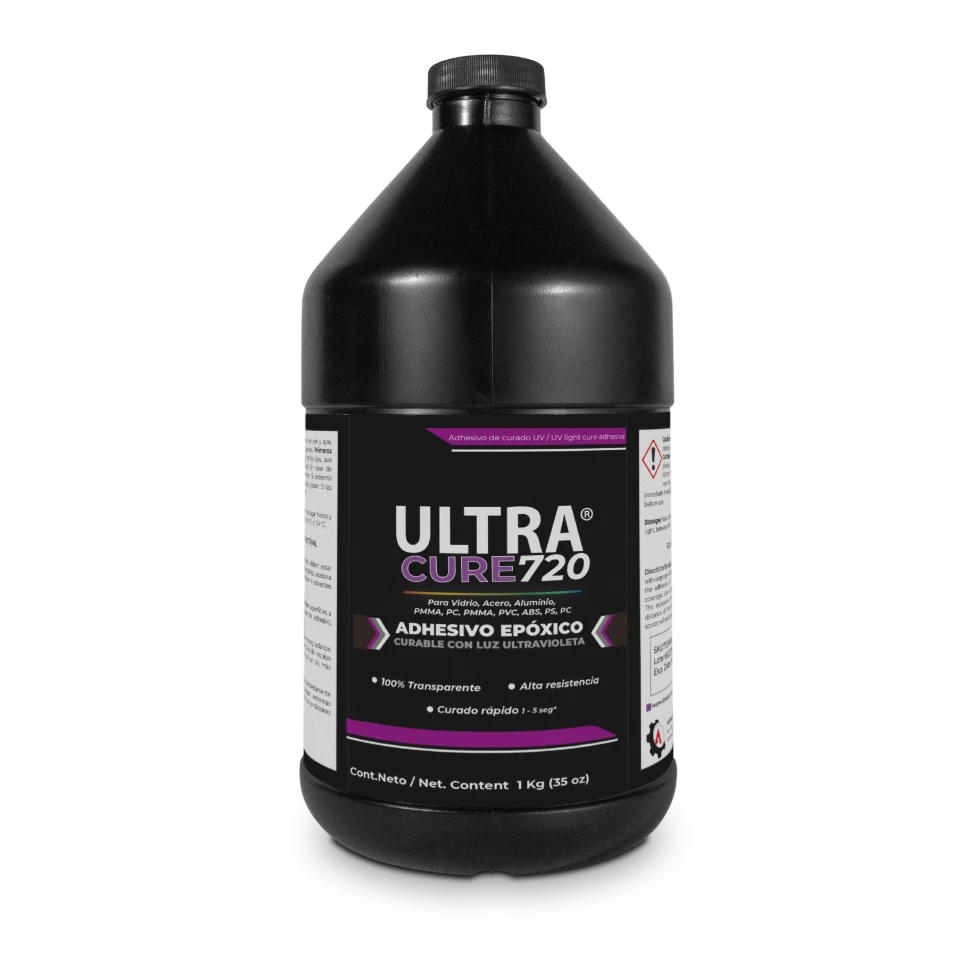
Description
The 720 is a high-hardness UV adhesive: a single-component structural UV epoxy that cures under ultraviolet light at 365 nm. It is the choice in the line when the bond has to stay rigid and dimensionally stable, with ≥ 2,755 PSI (≥ 19 MPa) in both tensile and shear strength and a Shore D hardness of 68 to 72.
As a low shrinkage UV adhesive, it stands apart from a conventional light-curing adhesive: the part does not shift out of alignment as it polymerizes, the defect that ruins a precision assembly that is already positioned. It also has a glass transition temperature of 302 °F (150 °C), well above the rest of the UV line, and an operating range of −22 to +275 °F (−30 to +135 °C).
High Hardness
Shore D 68 to 72 and ≥ 2,755 PSI (≥ 19 MPa) in both tensile and shear strength.
Low Shrinkage
The part does not shift out of alignment as it polymerizes.
Tg of 302 °F (150 °C)
Operating range of −22 to +275 °F (−30 to +135 °C).
How Do You Apply the 720 Low Shrinkage UV Adhesive?
1. Substrate surfaces must be clean and free of grease. Use isopropyl alcohol or soapy water.
2. Apply the adhesive to one of the surfaces to be bonded, in a 0.1 mm layer.
3. Assemble the parts.
4. Clean any excess adhesive with isopropyl alcohol before UV exposure.
5. Project 365 nm UV light onto the joint, at a recommended distance of 2 cm.
6. Allow the adhesive to develop full strength before applying loads (typically 24–48 h depending on bond conditions).
Additional Information
- When the assembly vibrates or expands. It cures rigid (Shore D 68–72). If the bond has to absorb vibration or follow dimensional changes without cracking, the product in the line is the 705, which cures flexible.
- If both substrates are opaque. Light curing requires at least one of them to let 365 nm radiation through. Polycarbonate and UV-absorbing acrylic absorb 365 nm light: verify with a radiometer, behind the substrate, the irradiance that reaches the adhesive.
- On PP, PE, PTFE, silicone or polystyrene. Not recommended.
- In bonds with a gap greater than 3 mm. The recommended layer is 0.1 mm.
- Setting Time by Curing System: UV lamp 200 mW/cm² < 15 seconds · ULTRACURE UV3651 2.7 W/cm² < 10 seconds · ULTRACURE UV2025 4 W/cm² < 5 seconds (0.1 mm layer at a 2 cm distance)
- Compatible: ABS · Polycarbonate (PC) · PET · PMMA (acrylic) · PVC · Glass · Aluminum · Stainless steel · Polyurethane (PU)
- Not recommended: Polystyrene (PS) · Polyethylene (PE) · Polypropylene (PP) · PTFE · Silicone
- Light protection: keep the container closed and protected from light when not in use, and never return leftover adhesive to the original container.
- Safety: during curing, wear UV protective goggles and gloves; do not look directly at the lamp. Refer to the SDS before use.
- Complies with the RoHS Directive (EU 2011/65/EU and EU 2015/863) and with the REACH Regulation (EC No 1907/2006): it contains no RoHS-restricted substances above the limits and no Substances of Very High Concern (SVHC) above 0.1% (w/w).
- +
Appearance
Clear liquid
Main curing
Ultraviolet light (365 nm)
Viscosity @ 77 °F
10,000–12,000 cP
Hardness (Shore D)
68–72
Tensile strength
≥ 2,755 PSI (≥ 19 MPa)
Shear strength
≥ 2,755 PSI (≥ 19 MPa)
Glass transition temperature (Tg)
302 °F (150 °C)
Water absorption (24 h @ 77 °F)
< 1.5 %
Operating temperature
−22 to +275 °F (−30 to +135 °C)
Density @ 77 °F
1.02–1.04 g/cm³
Volume resistivity
3.8 × 10¹⁵ Ω·cm
Surface resistivity
1.7 × 10¹⁵ Ω
Recommended exposure distance
2 cm
Flash point
221 °F (105 °C)
Packaging
50 ml, 250 ml and 1 kg containers.
Storage
47 to 75 °F (8 to 24 °C), in a cool, dry place, in the original sealed container, protected from light. Shelf life: 12 months from the date of manufacture.
720 Frequently Asked Questions
In rigidity and temperature. The 720 cures hard —Shore D 68–72— with ≥ 2,755 PSI (≥ 19 MPa) tensile and shear strength and a Tg of 302 °F (150 °C). The 705 cures flexible —Shore A 55— with ≥ 1,085 PSI (≥ 7.5 MPa) and absorbs vibration. If the assembly has to hold load and geometry, choose the 720; if it has to follow movement without cracking, the 705.
Because an adhesive that shrinks as it cures moves the part. In a precision assembly that is already positioned, that shrinkage throws the assembly out of alignment and ruins the tolerance, even if the bond itself is strong. Its low shrinkage is what lets it cure without losing the position set before exposure.
Its operating range is −22 to +275 °F (−30 to +135 °C), and its glass transition temperature is 302 °F (150 °C). That Tg is the highest declared in the brand's UV line and it is the figure to check if the assembly runs hot: above the Tg the material softens and loses mechanical properties.
A 365 nm UV curing lamp, at a distance of 2 cm. With the ULTRACURE UV2025 at 4 W/cm², setting is reached in under 5 seconds; with the UV3651 at 2.7 W/cm², in under 10; and with a 200 mW/cm² source, in under 15. The measurement corresponds to a 0.1 mm layer.
Yes. It complies with the RoHS Directive (EU 2011/65/EU and EU 2015/863) and with the REACH Regulation (EC No 1907/2006): it contains no RoHS-restricted substances above the limits and no Substances of Very High Concern (SVHC) above 0.1% (w/w). The statement covers the declared composition; a supporting declaration of conformity is available on request.
No. Light curing requires at least one of the two substrates to be translucent and let 365 nm radiation through. It is a physical limitation of light curing, not of the product, and it has to be solved in the joint design before choosing the adhesive.
In 50 ml, 250 ml and 1 kg containers. Store them at 47 to 75 °F (8 to 24 °C), in a cool, dry place, in the original sealed container, protected from light, with a shelf life of 12 months from the date of manufacture.
It cures to a rigid material of Shore D 68–72, with a crystalline, scratch-resistant surface, and reaches ≥ 2,755 PSI (≥ 19 MPa) in tensile and shear strength. That hardness is what holds the geometry of the assembly under load; its high viscosity of 10,000 to 12,000 cP makes it suited to encapsulation, bonding and sealing. If the joint needs flexibility, the product in the line is the 705.
Five figures, each with its test condition: hardness (Shore D 68–72); tensile and shear strength (≥ 2,755 PSI / ≥ 19 MPa); glass transition temperature against the working temperature (Tg of 302 °F (150 °C) and an operating range of −22 to +275 °F (−30 to +135 °C)); shrinkage during cure (it is a low shrinkage UV adhesive); and the wavelength and irradiance at which setting time was measured (365 nm; under 5 seconds at 4 W/cm²). A figure without its condition cannot be compared.
Where to Buy
ULTRACURE 720?
Find it through our distributor network in 50 ml, 250 ml and 1 kg containers.
Are you a distributor? Join our network and offer your customers UV-curing adhesives for industrial assembly.